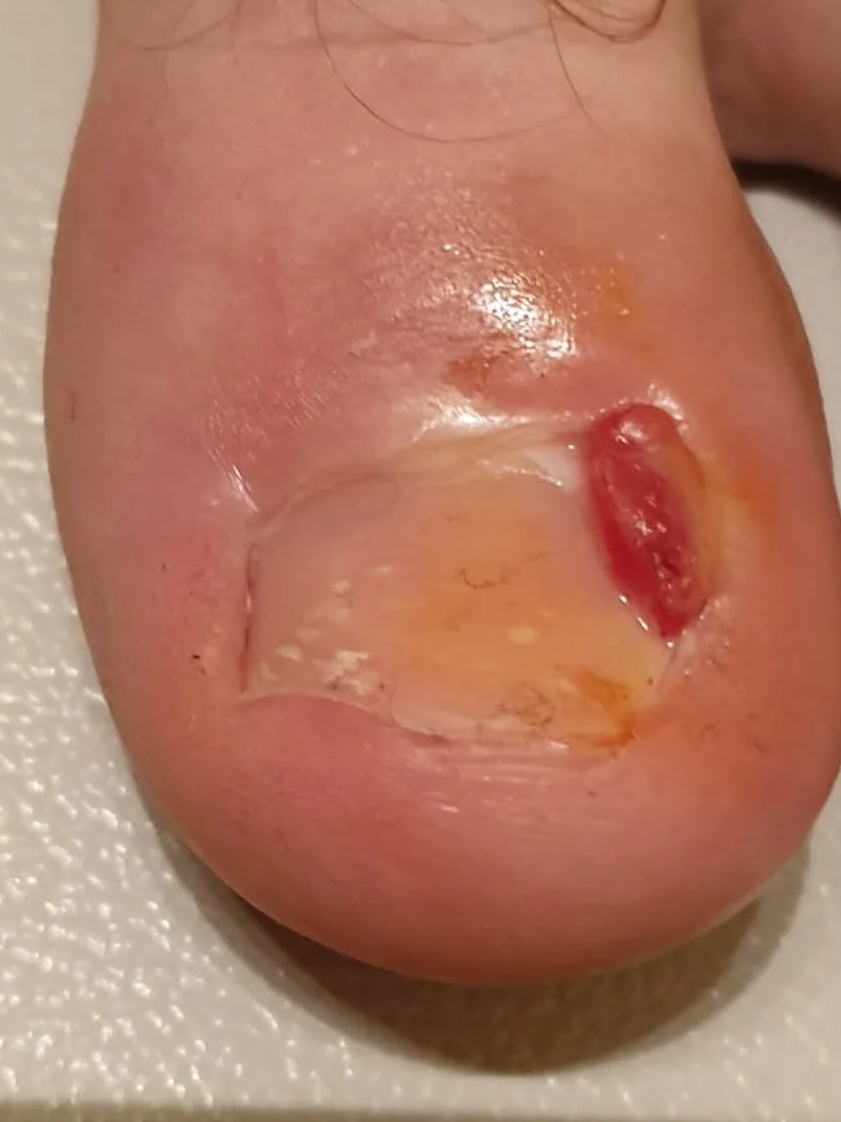
Hypergranulation tissue- Ingrown toenail complication
Image is owned by our clinic and should not be reproduced.
Ingrown Toenail complications | Perth Nail Surgery Clinic
Hypergranulation tissue is a common complication of an ingrown toenail and can cause significant pain, swelling, bleeding and difficulty wearing shoes. It occurs when the skin surrounding the affected toenail produces excessive healing tissue in response to ongoing irritation, inflammation or infection.
Often appearing as a red, moist lump of tissue growing alongside or over the edge of the toenail, hypergranulation tissue is sometimes mistaken for an infection or an abnormal growth.
Although it may initially appear to be a minor problem, untreated hypergranulation tissue can become increasingly painful and make walking uncomfortable. In many cases, the underlying cause is an ingrown toenail that continues to penetrate and irritate the surrounding skin.
At Perth Nail Surgery Clinic, we provide specialist assessment and treatment for ingrown toenails, including cases complicated by excessive granulation tissue, infection and recurrent inflammation.
What is hypergranulation tissue?
Hypergranulation tissue, commonly referred to as proud flesh, is an excessive growth of soft tissue that develops during the wound-healing process.
When a toenail becomes ingrown, its sharp edge can penetrate the surrounding skin, creating a small wound. The body's natural healing response causes new tissue and blood vessels to develop around the injured area.
However, when the nail continues to press into or penetrate the skin, the repeated irritation can stimulate an excessive healing response. This results in the formation of raised, red, fragile tissue that can grow over the nail edge.
This tissue is particularly prone to bleeding because it contains numerous small blood vessels. It can also remain inflamed and painful while the offending nail edge continues to irritate the surrounding skin.
What does hypergranulation tissue from an ingrown toenail look like?
Hypergranulation tissue has a distinctive appearance and can usually be identified by its colour, texture and location around the affected toenail.
Common signs include:
Raised red tissue: A bright red or pink fleshy lump develops alongside the toenail.
Moist or shiny appearance: The tissue often looks wet, raw or glossy.
Easy bleeding: The delicate tissue may bleed with minimal contact, when drying the toe or when wearing shoes.
Swelling: The surrounding nail fold may become enlarged, inflamed and tender.
Overgrowth of skin: The tissue can grow over the nail edge, partially obscuring the toenail.
Discharge: Clear fluid or yellowish discharge may develop, particularly when inflammation or infection is present.
Persistent tenderness: The affected area may be painful when touched, squeezed or exposed to pressure from footwear.
What causes hypergranulation tissue to develop?
The most common underlying cause is an ingrown toenail that repeatedly damages the surrounding skin.
Several factors can contribute to its development:
1. Persistent nail penetration
When the edge or corner of the toenail grows into the surrounding skin, it creates ongoing irritation. The body responds by producing additional healing tissue, which can become excessive.
2. Repeated trauma and pressure
Tight footwear, repetitive pressure and activities that place stress on the toes can aggravate an ingrown toenail and stimulate further inflammation.
3. Infection and inflammation
Bacterial infection can develop when the skin barrier is broken. This may increase swelling, discharge and inflammation around the nail fold.
4. Incorrect toenail cutting
Cutting toenails too short, rounding the corners or attempting to dig out the nail edges can leave sharp nail fragments that penetrate the surrounding skin.
5. Recurrent ingrown toenails
Patients who repeatedly experience ingrown toenails may develop chronic inflammation and persistent hypergranulation tissue, particularly when the underlying nail shape or offending nail edge has not been adequately addressed.
How is hypergranulation tissue treated?
Treatment depends on the severity of the ingrown toenail, the amount of excess tissue present and whether infection has developed.
The most important part of treatment is addressing the underlying cause. Simply reducing the excess tissue without removing the source of irritation may result in the problem returning.
1. Professional removal of the ingrown nail edge
When the nail edge is penetrating the surrounding skin, a podiatrist may recommend a partial nail avulsion.
This minor surgical procedure involves:
Administering local anaesthetic to numb the affected toe.
Carefully removing the offending section of ingrown toenail.
Removing any retained nail fragments or sharp nail spicules.
Allowing the inflamed nail fold to settle and heal.
Removing the offending nail edge eliminates the source of ongoing irritation and allows the surrounding tissue to recover.
2. Removal or reduction of hypergranulation tissue
When excessive granulation tissue has developed, additional treatment may be required.
Depending on its size and severity, treatment may include:
Debridement: Carefully removing excessive or unhealthy tissue to reduce the bulk of the overgrowth.
Surgical excision: Removing larger or persistent areas of excessive tissue when clinically indicated.
Treatment is generally more effective when the offending nail edge is addressed at the same time.
For patients who experience recurring ingrown toenails or persistent hypergranulation tissue, permanent nail surgery may provide a more definitive solution.
This procedure involves removing the problematic section of the toenail and treating the corresponding nail matrix (the area responsible for nail growth).
Common techniques include:
Partial nail avulsion with chemical matrixectomy: The offending nail border is removed and a chemical, commonly phenol, is applied to the corresponding nail matrix to prevent that section from growing back.
Winograd procedure: A surgical technique involving removal of the affected nail border and associated nail matrix tissue. Depending on the presentation, excess surrounding tissue may also be removed.
These procedures aim to prevent the offending nail edge from regrowing into the surrounding skin, reducing the likelihood of recurrent inflammation and hypergranulation tissue.
4. Treatment of associated infection
If an ingrown toenail becomes infected, appropriate treatment is important.
Signs of infection may include:
Increasing redness and warmth.
Swelling around the nail fold.
Pus or thick yellow discharge.
Increasing pain or throbbing.
Redness spreading beyond the immediate nail area.
Depending on the severity, treatment may involve drainage of an abscess, removal of the offending nail edge and antibiotics when there is an indication of bacterial infection.
Antibiotics are not routinely required for every ingrown toenail with granulation tissue. Removing the source of irritation is often the most important part of treatment.
Can hypergranulation tissue go away on its own?
In mild cases, hypergranulation tissue may gradually reduce once the irritation causing it has been eliminated.
However, if the toenail continues to penetrate the surrounding skin, the tissue may persist, enlarge or become increasingly inflamed.
Larger areas of hypergranulation tissue are unlikely to resolve properly while the underlying ingrown nail remains untreated.
It is therefore important to have the toe assessed by a podiatrist, particularly if the tissue is repeatedly bleeding, growing over the nail or causing difficulty walking.
What happens if hypergranulation tissue is left untreated?
Ignoring an ingrown toenail with excessive granulation tissue can lead to ongoing discomfort and further complications.
Potential problems include:
Increasing tissue overgrowth: The red fleshy tissue may enlarge and extend over the nail edge.
Persistent bleeding: Fragile tissue can bleed repeatedly with minor contact.
Chronic inflammation: Continued nail penetration can prevent the surrounding skin from healing.
Secondary infection: Broken skin can allow bacteria to enter the surrounding tissue.
Difficulty wearing shoes: Swelling and tenderness can make everyday footwear uncomfortable.
Recurrent ingrown toenails: Without addressing the underlying nail problem, the condition may continue to return.
If redness spreads rapidly, you develop a fever, or you experience significant worsening pain, seek prompt medical attention. People with diabetes, poor circulation or a compromised immune system should seek professional assessment early
When should you see a podiatrist?
You should arrange an assessment if you notice:
Red, fleshy tissue growing alongside your toenail.
Bleeding from the nail fold.
Persistent swelling or inflammation.
Yellow or cloudy discharge.
Pain when walking or wearing shoes.
An ingrown toenail that keeps returning.
Excess tissue that appears to be growing over the toenail.
Early treatment can prevent the condition from progressing and may avoid more extensive surgery.